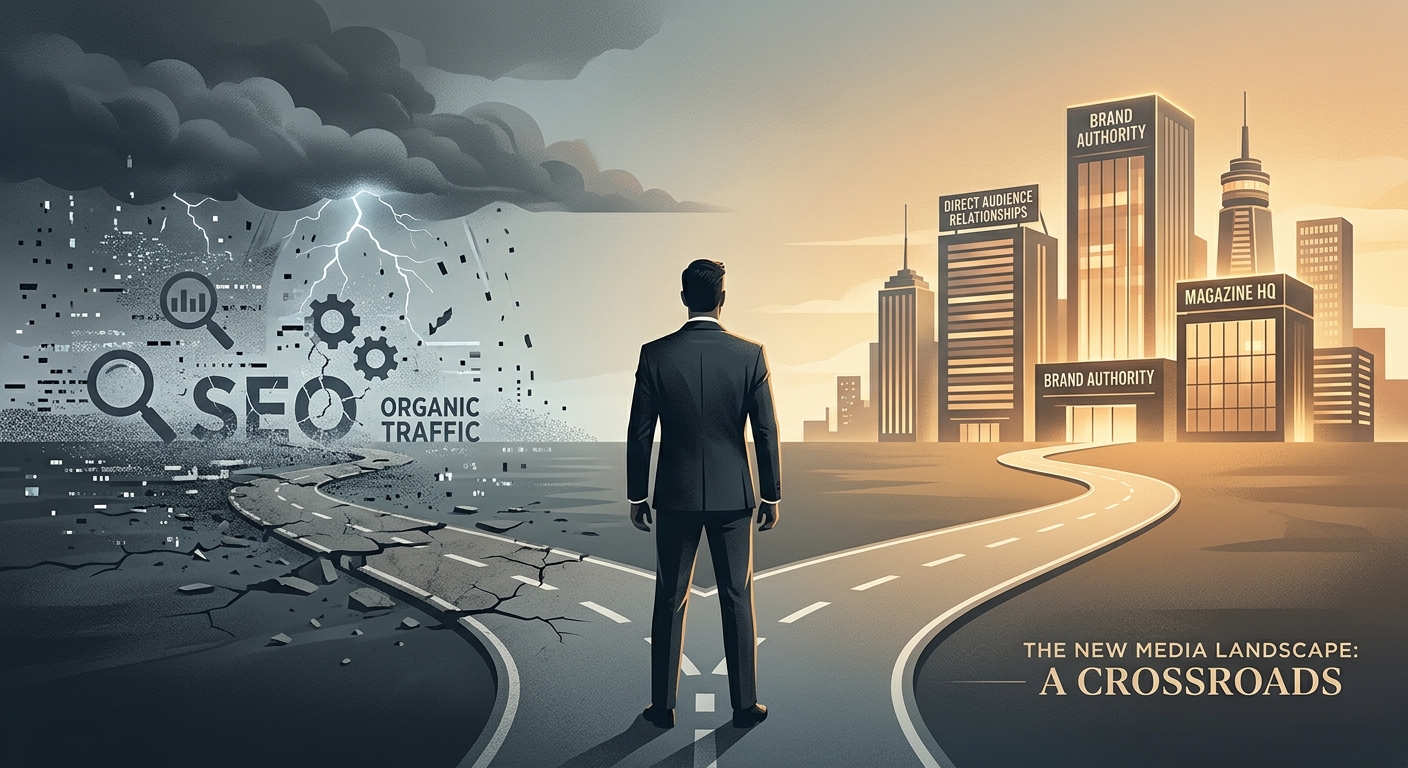
Two stories landed yesterday that, taken together, tell you more about where publishing is headed than any conference keynote will this year.
In one, the CEO of Condé Nast told Peter Kafka that he has instructed every business unit to plan around getting zero traffic from Google Search. In the other, a financial publisher called MarketBeat cut 42% of its email subscriber list — and revenue went up.
Both stories point in the same direction: the growth-at-all-costs era of digital publishing is over. What replaces it rewards the things that are hardest to fake — brand authority, audience quality, and direct relationships.
Roger Lynch’s “Zero Search” Mandate
On this week’s Channels with Peter Kafka, Condé Nast CEO Roger Lynch was unusually blunt about Google. Search referrals are declining “precipitously,” he said, and direct traffic — people typing in URLs — is now the majority of Condé Nast’s audience. Google Discover still sends volume, but it doesn’t convert to subscriptions or commerce. It’s junk traffic by comparison.
So Lynch told his teams to stop hoping and start planning:
“I told all of our teams, you need to plan your businesses around there being no search. And if you don’t have a plan for that, you may not have a business.”
— Roger Lynch, CEO of Condé Nast
This isn’t abstract strategy. Condé Nast’s digital subscriptions grew 29% last year. Events revenue is up 50-60% year over year — the Met Gala alone generated 3.1 billion video views, up from 2.1 billion the year before. Lynch has AI licensing deals in place with OpenAI, Amazon, Microsoft, and Perplexity, but he’s drawing a hard line: no deal that allows AI to display Condé Nast content verbatim.
His thesis is that “taste” and editorial authority are the one moat AI can’t replicate. And he says AI companies are starting to agree — their models underperform on exactly the kind of editorial judgment that brands like Vogue and The New Yorker are built on, which has actually strengthened Condé Nast’s negotiating position.
Lynch also confirmed that succession planning is underway for both Anna Wintour and David Remnick, with emergency successors already identified. That’s the kind of institutional planning you only do when you believe the institution has a future worth protecting.
MarketBeat Cut Its Email List by 42% and Grew Faster
A Media Operator reports that financial publisher MarketBeat slashed its email subscriber list from 6.2 million to 3.6 million. The result: year-to-date revenue is up 25%, advertising sales are up 40%, and the company is on track for $60-65 million in 2026 revenue with 50% net margins.
What happened? Email service providers are tightening the screws. They now demand subscribers who both open and click regularly. Purchased lists and co-registration signups — the growth hacks that built many a media business over the past decade — are becoming liabilities. Founder Matt Paulson says the new bar is that 40% of signups need to become active clickers. MarketBeat isn’t there yet, but the direction is clear.
There’s an AI angle too. MarketBeat dropped its premium subscription price from $399 to $249 because free AI tools now replicate much of the investment research its subscribers were paying for. The 11,500 premium subscriber count has held, but the ceiling has dropped. Meanwhile, YouTube (600K subscribers, up from 163K in March 2025) and Facebook video have become the new top-of-funnel, replacing email acquisition.
A separate piece in The Audiencers reinforces the point: newsletter open rates are nearly meaningless as a quality signal thanks to Apple Mail Privacy Protection inflating numbers artificially. The metric most publishers use to justify their email businesses is broken.
Meanwhile, in the News Business
The New York Times is dealing with fierce backlash over a Nicholas Kristof column detailing sexual abuse allegations against Palestinians in Israeli detention. Israeli officials called it “blood libel.” The Times defended Kristof’s reporting institutionally, but the newsroom itself has stayed conspicuously silent — a gap that’s becoming its own story. (Status, paywalled)
Axios Media Trends Executive reports that potential 2028 presidential candidates are building full creator-media operations — podcasts, Substacks, social video channels, merch stores — growing national followings that bypass traditional news distribution entirely. As local news continues to decline, politicians who master the creator model gain a structural advantage over those who rely on earned media. Separately, progressive outlets are seeing a resurgence in investment and audience engagement under Trump 2.0. (Axios, paywalled)
And News Corp posted a 13% jump in Q3 net income, with CEO Robert Thomson taking aim at “bad boy bots” scraping publisher content. (Capital Brief)
What This Means for WordPress and the Open Web
If you strip away the names and numbers, yesterday’s stories all tell the same story: the era of rented audiences is ending. Google Search traffic is declining. Email lists built on purchased signups are becoming toxic. AI is compressing the value of commodity information. Political figures are building their own media operations instead of relying on publishers to reach audiences.
What survives? Direct relationships. Brand authority. Owned platforms.
This is where WordPress fits — not as a nostalgic callback to the blogging era, but as infrastructure for the publishing model that’s actually working. When Lynch says Condé Nast’s direct traffic is now the majority of its audience, he’s describing a world where your domain, your CMS, and your direct relationship with readers matter more than any platform referral. When MarketBeat proves that a smaller, engaged email list outperforms a bloated one, it’s an argument for publishers who control their own stack and can build real engagement loops rather than just spraying newsletters into the void.
The publishers who will thrive in the next five years are the ones building on platforms they own, cultivating audiences that come directly to them, and creating value that AI can’t easily replicate. WordPress powers a disproportionate number of those publishers. The question isn’t whether open-web publishing has a future. It’s whether the WordPress ecosystem moves fast enough to give publishers the tools they need for the post-search, post-scale era — better personalization, smarter engagement, tighter integration between content and commerce.
Lynch bet Condé Nast on taste. MarketBeat bet on quality over scale. Both are winning. The open web has the same structural advantages if it chooses to use them.