Media Trendlines — July 3–5, 2026
📰 Key Themes
- Cloudflare moved to charge AI companies each time they use a publisher’s content in an answer, the most concrete attempt yet to build a market for the words that feed AI — but its fate rests entirely with the buyers, not the publishers.
- The FCC changed the booking habits of one of daytime television’s biggest shows without issuing a single formal order, a reminder of how much editorial behavior a regulator can reshape just by opening a file.
- Comcast’s plan to spin off NBCUniversal was supposed to unlock a wave of dealmaking; a week later the market decided the conglomerate discount was smaller than everyone assumed, and the buyers outnumber the sellers.
- The Onion turned its takeover of InfoWars into a live media business, proving satire can carry real revenue and a moral franchise at the same time.
- From Cloudflare’s pricing scheme to Reddit’s war on AI slop to Google delisting a real investigation over an anonymous copyright claim, the machinery of the open web is being rebuilt around who gets paid when a machine reads the page.
Jump to: 💡 Business Model Innovation · 📺 Big Media Moves · 📎 Also Noted · 🧭 Takeaways
💡 Business Model Innovation
Cloudflare’s Pay-Per-Answer Plan Shows Publishers Still Don’t Set the Price of Their Own Work
Source: The Media Copilot (Pete Pachal)
Exactly one year after it began letting sites block AI crawlers by default, Cloudflare used Canada Day again to push the fight forward. Its new Pay Per Use framework charges AI companies not when a bot crawls a page, but when the content is actually used in an answer. It is a meaningful correction to last year’s Pay Per Crawl model, which mispriced the transaction in both directions: a single crawl could feed thousands of AI answers, or none at all. Pay Per Use ties the payment to the moment of value, and promises publishers analytics on how their material is being consumed.
The plumbing is clever. Cloudflare’s Monetization Gateway sits in front of a request, quotes a price, takes a payment, hands back a receipt, and only then serves the content — no account creation, no checkout page, run over an open protocol. Cloudflare can pull this off because it already sits in front of roughly a fifth of the web and classifies the bots as they arrive. That reach is the whole argument: the micropayment economics that killed a dozen earlier schemes only work when someone is already managing the traffic.
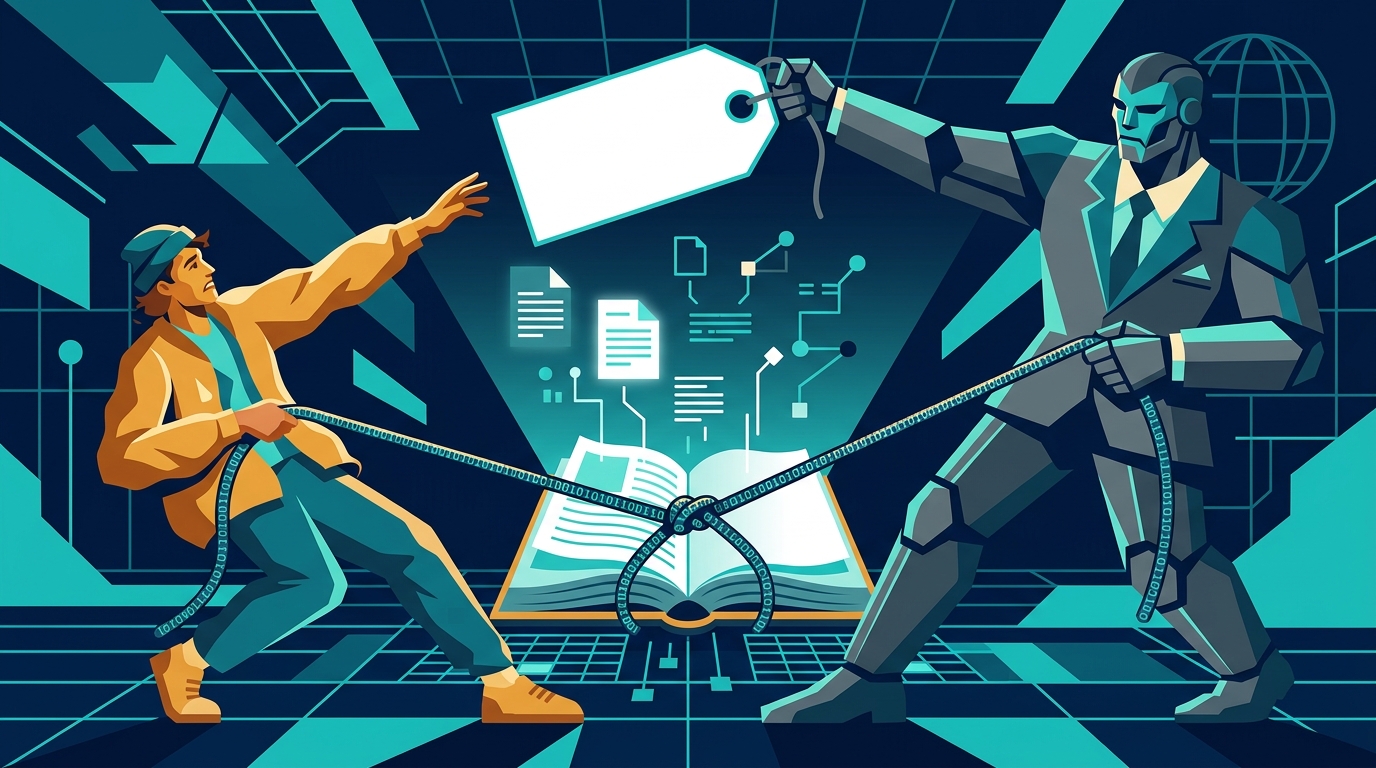
Here is the part publishers should sit with. Cloudflare is refreshingly candid that this is an experiment, and its success hinges on a single equation — whether an AI company finds it cheaper to get the data it wants through Cloudflare than around it. As Pachal put it, nobody typing a question into Google or Claude is choosing which article to pay for; that decision is made at the company level, and companies buy the most data for the least cost. Which means the mechanism is real, the analytics are welcome, and the pricing power still belongs to the buyer. A market where the seller can set a rate but the buyer decides whether the rate is worth honoring is not yet a market on the seller’s terms. It is a toll booth on a road the AI companies can still choose to avoid.
The WordPress angle: Infrastructure, not the CMS, is where this fight is being settled — Cloudflare adjudicates the transaction long before a request reaches a publisher’s stack. But the long tail of independent sites that any usage market needs to reach scale runs overwhelmingly on WordPress, and those are exactly the operators without a licensing team to cut a bespoke AI deal. A default, edge-level toll is the only version of content payment that ever reaches them. If Pay Per Use works, it works because it meets small publishers where they already are; if it stays an experiment, it is because it never did.
The Onion Turned a Legal Grudge Into a Working Media Business
Source: Status (Oliver Darcy) ⚠️ Paywalled — summary based on available preview only.
In an interview with Status, The Onion CEO Ben Collins laid out what the satirical outlet has built on top of its contested takeover of Alex Jones’s InfoWars: a parody version of the brand with Thursday-night livestreams hosted by young comedians, fake supplements, and merchandise that raised more than $100,000 for Sandy Hook families in its first month — 100% of it passed through. Jones declared InfoWars “dead” on air while still posting from its accounts, and the underlying purchase remains snarled in an eleven-month emergency stay. Collins’s stated ambition, in the outlet’s house register: “Total world domination.”
Strip away the bit and there is a genuine model here. The Onion is running a live-programming operation, a commerce line, and a philanthropic franchise off a single acquisition, and doing it with the kind of cultural velocity — trending on Threads and Bluesky within a day — that legacy outlets spend millions chasing. Satire has always been cheap to produce and hard to monetize; The Onion is demonstrating that a sharply defined voice attached to a real-world cause can be both a content engine and a fundraising one. The lesson for straight-news publishers is uncomfortable but real: audiences will fund a brand they believe stands for something, and “stands for something” is a product decision, not a marketing one.
Reddit Bets Its Users Will Reject the Slop Its Rivals Can’t Filter
Source: Semafor (Mixed Signals)
As every platform drowns in AI-generated filler, Reddit CEO Steve Huffman offered a contrarian answer on Semafor’s Mixed Signals: don’t fight the slop algorithmically, let the communities reject it. Reddit can’t actually ban AI-written posts, he said, but “if you’re lazy, the communities will reject it, and we want to empower them to reject it.” He is leaning into Reddit’s role as the internet’s “anti-social media” hub — a place where you can’t get famous or rich from posting — even as the company sues Anthropic over data use.
It is a convenient philosophy for a company whose product is unpaid human labor, but it is also a real strategic bet: that the scarce asset in an AI-saturated web is credibly human judgment, and that a community willing to downvote garbage is worth more than a model trying to detect it. Publishers who have spent a decade optimizing for reach should note which way the wind is blowing — the platforms that survive the slop era may be the ones that make originality legible, not the ones that maximize volume.
Google Delisted a Real Investigation Over an Anonymous Copyright Claim — Twice
Source: The Media Copilot
For the second time this year, Google removed and then reinstated a Press Gazette investigation under a DMCA complaint, restoring it only after the outlet pressed for comment. The reporting detailed how a U.K. marketing company bought three established football news sites and stuffed them with error-riddled AI-generated stories. The irony writes itself: an automated copyright system, built to move fast and sort out the truth later, became a tool to bury accurate reporting about AI slop. It is a live demonstration that the takedown machinery publishers depend on for protection can be turned against them by anyone willing to file anonymously.
📺 Big Media Moves
The FCC Reshaped ‘The View’ Without Filing a Single Demand
Source: Semafor (Max Tani)
According to a Semafor analysis, ABC‘s The View — a mandatory campaign stop for a generation of politicians — hasn’t hosted a candidate in a competitive race since February, when the FCC opened an investigation into the show’s compliance with the “equal time” rule. The program recently rebuffed a pitch to have two democratic socialists accompany New York mayor Zohran Mamdani on air, with one person citing caution over the open probe. ABC maintains The View is a bona fide news program not subject to the rule.
This is the quiet part of media regulation, and it is more effective than any fine. FCC Chairman Brendan Carr hasn’t made a formal demand; the mere existence of the file changed the show’s behavior. For any broadcaster operating under a license the government can review, the calculus is now defensive by default — and defensive programming is, functionally, a softer editorial product. The chilling effect isn’t a side effect of the investigation. On this evidence, it is the investigation.
Comcast Wanted to Kick Off a Deal Wave. The Market Called Its Bluff.
Source: Semafor (Rohan Goswami)
Comcast‘s decision to spin off NBCUniversal briefly lifted Charter on the theory that a freed NBCU meant big M&A was coming. The pop faded by week’s end. The conglomerate discount everyone pegged north of 25% turned out, one telecom CEO told Semafor, to be a quarter of that. As CNBC’s Alex Sherman and Lillian Rizzo noted, a deal could take years: both NBCU and Comcast are too big to be prey and not big enough to be predators, and Charter’s roughly $100 billion debt load makes it an unappetizing target.
The read-through matters beyond these two companies. The spinoff logic of the past two years assumed that separating distribution from content would let the pieces find eager buyers. This week the market said the pieces are worth less apart than the pitch decks claimed, and that there are more would-be buyers than sellers willing to move. That is a harder environment for every media owner betting a breakup will unlock value — the discount you are trying to escape may be smaller, and the exit narrower, than the strategy assumed. Comcast’s dealmakers won’t stay quiet forever, but for now they are buyers in a seller’s market with no seller in sight.
Murdoch’s Op-Ed Pages Break With Trump on Corruption
Source: Semafor (Graph Massara)
After a week of disclosures about the president’s finances, the editorial pages of the Murdoch-owned Wall Street Journal and New York Post — generally Trump-friendly — compared the first family’s conduct to “Hunter Biden-style sleaze” and warned of electoral consequences. It follows earlier op-ed critiques over a planned Iran deal. The through-line worth watching: even inside an aligned ownership structure, opinion desks retain enough independence to break on a specific issue, and anti-corruption is the fault line where that independence still shows.
📎 Also Noted
🔹 A Pew survey finds 56% of U.S. adults now support banning social media for users under 16, with 78% backing age verification, as the Kids Online Safety Act clears the House and Democrats roll out a “kids over clicks” framework — regulatory pressure on platforms is becoming bipartisan. (Semafor)
🔹 Substack rolled out country leaderboards and inline translation tools as it leans into international expansion after its latest raise. (Semafor)
🔹 Mark Zuckerberg is personally courting fashion and culture journalists to promote Meta’s new smart glasses — a reminder that platform owners still need editorial credibility to sell hardware. (Semafor)
🔹 Netflix’s biggest hits are struggling to hold audiences into a second season, with shows like Beef and The Four Seasons shedding more than half their viewers — a retention problem that complicates the “own the franchise” streaming thesis. (Semafor, via Bloomberg)
🔹 Hyve bought legal-tech events brand LegalTechTalk — its eighth acquisition since 2024 and first since agreeing to a Hellman & Friedman buyout — betting that founder-led “ecosystem” events in disrupted industries are the durable core of B2B media. (A Media Operator)
🔹 The Intercept’s Signal account was breached and used to contact potential sources under the outlet’s name — a stark operational-security warning for every newsroom that runs on encrypted messaging. (Semafor, via Drop Site)
🔹 A Vanity Fair profile chronicles Politico CEO Goli Sheikholeslami balancing AI “survivalism” against the risk of moving too fast — the tension defining every legacy publisher’s AI strategy. (Semafor, via Vanity Fair)
🧭 Takeaways
- A price you can name is not a price you control. Cloudflare’s Pay Per Use gives publishers a rate card, but the AI companies still decide whether to pay it. Treat edge-level monetization as leverage worth building, not a settlement worth banking.
- Regulatory chill is now a programming input. The FCC bent The View without an order. Any publisher touching a broadcast license — or hoping to — should assume that an open investigation is itself the penalty.
- The breakup trade is getting harder. Comcast’s spinoff didn’t summon buyers, and the conglomerate discount was thinner than the Street assumed. If your value-unlock plan depends on eager acquirers, stress-test the assumption that they exist.
- Standing for something is a business model. The Onion is funding live programming and a moral franchise off one acquisition. Audience revenue follows conviction, and conviction is a product decision.
- The scarce asset is credible humanity. Reddit is betting communities will reject slop that algorithms can’t catch. In an AI-saturated web, making originality legible may matter more than maximizing reach.