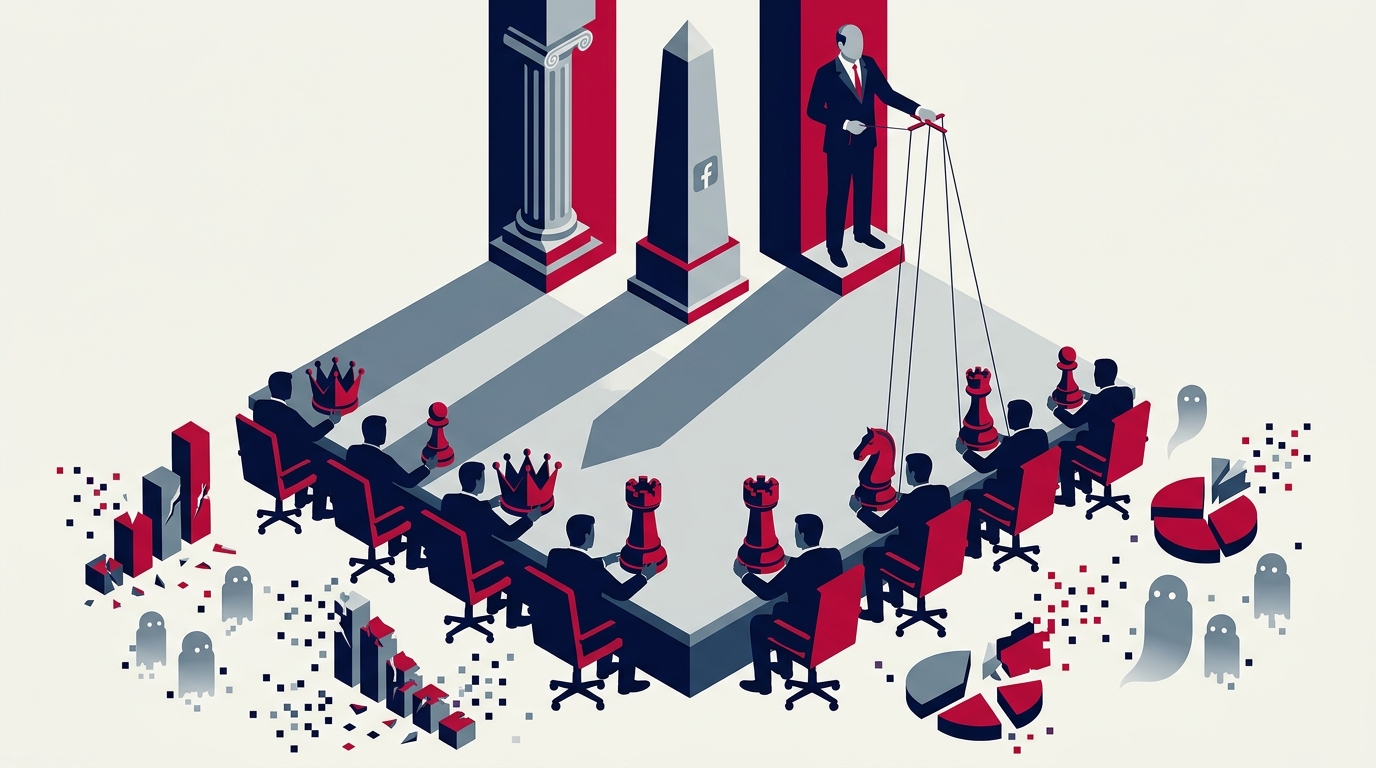
Media Trendlines — July 17–19, 2026
📰 Key Themes
- Publishers learned that more than half of all email clicks — and roughly three-quarters in B2B — are bots rather than readers, hollowing out the engagement metrics the audience business still runs on.
- Public confidence in newspapers fell to a near-record-low 17% in Gallup’s annual survey, with television news at 14% and confidence in Big Tech sliding to 20%.
- The Paramount–Warner Bros. Discovery merger reached a courtroom climax, with a federal judge set to rule this week and Paramount floating a threat to leave California if the deal is blocked.
- Axel Springer will hand its highest honor to MAGA financier Peter Thiel, with CBS News editor-in-chief Bari Weiss speaking — one of several signs media power is realigning around ideology rather than audience.
- With Google referrals drying up, publishers from RocaNews to The Atlantic are rediscovering Facebook as a distribution engine — even as OpenAI quietly staffs up to sell ads of its own.
Jump to: 📺 Big Media Moves · 💡 Business Model Innovation · 📎 Also Noted · 🧭 Takeaways
📺 Big Media Moves
Paramount’s Merger Now Hinges on a Threat to Flee California
Source: Semafor Media (Rohan Goswami) and Status
A federal judge will decide this week whether to freeze Paramount‘s takeover of Warner Bros. Discovery. Judge Araceli Martínez-Olguín heard emergency arguments over a temporary restraining order sought by a coalition of states, and even if she declines it, those states will keep pressing for a preliminary injunction that could tie the deal up for months. Paramount has reasons to want speed: it is on the hook for roughly $625 million payable to shareholders quarterly, due by the end of September. It has hired antitrust and Supreme Court counsel and argued the states have drawn the competitive market too narrowly.
The wild card is geographic. Semafor reported that if Paramount loses, it could move part of its business out of California — and Tennessee’s economic development chief has spent much of July courting the company toward Nashville’s growing center-right media cluster. California Attorney General Rob Bonta called the threat “a last-ditch effort to blackmail my office.” Governor Gavin Newsom, who met privately with Paramount’s David Ellison earlier this year, has stayed conspicuously quiet on his own AG’s lawsuit.
This is what late-stage consolidation looks like when the underlying business is shaky: the decisive leverage is not audience or product but jurisdiction and political favor. A studio negotiating its own merger by dangling jobs in front of a red state, while a Democratic governor goes silent to avoid crossing a donor, is a market being settled by power rather than competition. Whatever the judge rules Wednesday, the tell is that the fight has almost nothing to do with what viewers want and everything to do with who can absorb whom.
Axel Springer’s Toast to Peter Thiel Shows Where Media Money Is Really Aligning
Source: Status (Oliver Darcy / Natalie Korach)
Axel Springer will give its highest-profile honor, the Axel Springer Award, to Peter Thiel at a ceremony in Berlin in late September — and CBS News editor-in-chief Bari Weiss has agreed to speak at it. The pairing is loaded. Thiel secretly bankrolled the lawsuit that destroyed Gawker; handing him a journalism award is chief executive Mathias Döpfner‘s clearest signal yet of the publisher’s rightward turn. And Weiss’s participation caps an unusual courtship: last year Döpfner privately tried to buy Weiss’s The Free Press for roughly $120 million, only for her to sell instead to David Ellison‘s Paramount, which installed her atop CBS News.
Read alongside the Free Press–ification of CBS — Weiss has been steadily importing her contributors into the network’s newsroom — the through-line is that editorial control at scale is increasingly changing hands on ideological terms, not commercial ones. Owners are buying alignment, and journalists are accepting the trade for reach and resources. That is a legitimate way to run a media company. It is also a reason the trust numbers keep falling: audiences can feel the difference between an outlet organized around them and one organized around its patron.
The Times Fights Subpoenas Aimed at Its Reporters’ Sources
Source: Status (Jon Passantino)
The Trump administration subpoenaed three New York Times reporters — Julian Barnes, Eric Lipton, and Eric Schmitt — to testify before a grand jury about their confidential sources, over the paper’s reporting on security concerns around the Qatari-donated jet the president wants to use as Air Force One. U.S. District Judge Arun Subramanian granted a temporary reprieve, postponing the appearances pending a hearing this week on the paper’s motion to quash. Executive editor Joe Kahn has been drawn directly into what could become a precedent-setting clash with the Justice Department. It is the same story as the merger and the awards ceremony from a third angle: the state is now an active participant in deciding how media operates.
💡 Business Model Innovation
More Than Half of Email Clicks Are Bots — and the Whole Audience Business Should Take Note
Source: A Media Operator (Kari McMahon)
The bot-click problem that plagued B2B newsletters has arrived in consumer inboxes. More than 50% of email clicks are now non-human, according to email service provider Omnivery — roughly three-quarters in B2B and about half in B2C, and climbing. As recently as late 2025, over 90% of clicks on Gmail and Yahoo addresses were real people; the security scanners that pre-fetch links before delivery have since flooded the numbers. “Bot clicks are impacting B2C and B2B, and quite frankly, they’re only getting worse,” said Omnivery’s Jack Wrigley. Even the best providers, one Upland Adestra product manager noted, catch only about 80% of them.
The prescription is uncomfortable but correct: stop measuring interactions and start measuring outcomes — did the reader subscribe, buy, renew, show up. A newsletter that has spent years optimizing open and click rates has been optimizing a number that is now majority fiction. That has teeth for advertisers too, since ad networks pay per click; Wrigley says filtering bots saved one client more than $2 million a month in fraudulent exposure. Publishers who can prove their engagement is human will command higher rates precisely because so many can’t. “Email still works,” said Adestra’s John Hayes. “You just need to measure it properly.”
Put this next to the week’s other data point — Gallup’s finding that only 17% of Americans express confidence in newspapers, a near-record low, with TV news at 14% — and a pattern emerges. Publishers can trust neither their own analytics nor their standing with the public. When the foundations of the audience relationship get this soft, the temptation is to reorganize the business around things that still feel solid: owners, subsidies, and platforms. That is exactly what the rest of the weekend showed happening.
The WordPress angle: the shift from interactions to outcomes is ultimately an infrastructure decision. Open and click counts live inside someone else’s sending platform; subscriptions, renewals, and on-site behavior live in systems the publisher owns. The outlets best positioned for a bot-saturated inbox are the ones that treat first-party measurement — their own site, their own subscriber file, their own event data — as the source of truth rather than the metrics a third party hands them.
Facebook Is the New TikTok — Because It Still Delivers Real Humans
Source: A Media Operator (Christiana Sciaudone)
The platform everyone spent a decade writing off is quietly working again. RocaNews, the Gen Z outlet built on Instagram, started posting to Facebook “on a whim” and now pulls 10 million views a month there. The Atlantic‘s CEO Nick Thompson has been blunt about the economics: the publisher spends roughly $50 in Facebook ads to acquire a $60 subscription and scales that trade thousands of times over. “We’d be idiots not to use it,” he said. Reach Plc pivoted to Facebook after Google Discover traffic collapsed and grew accounts to between half a million and a million followers organically.
The catch is conversion. Tangle‘s Isaac Saul can buy new email signups on Meta for about a dollar each, but that cohort stubbornly refuses to pay, forcing a choice between engineering better onboarding or treating those readers as an ad-supported audience where scale matters more than conversion. That tension is the whole game. Facebook is attractive right now for the same reason the bot-click story is alarming: it is one of the few channels still delivering verifiable humans at volume. The discipline that separates winners is whether borrowed reach gets converted into a direct, owned relationship — or simply rented again, one platform after the last one failed.
CBS Bets on Podcasting as the Networks Play Catch-Up
Source: Semafor Media (exclusive)
CBS News is hiring Mike Pesca, longtime host of the daily podcast The Gist and a Free Press contributor, as its editorial director for podcasting — the latest of Bari Weiss’s hires and another push into audio, after new shows with Jill Schlesinger and Norah O’Donnell. The legacy networks have lagged their audio-first and digital-native rivals here for years; NBC’s Dateline is the rare franchise that translated. The bet is defensible on the numbers, but Pesca’s own framing is the honest caveat: podcasting, he said on his last Gist episode, is “the cousin of video.” The networks are chasing an audio audience at the exact moment the money and attention keep migrating to the camera.
OpenAI Is Quietly Building an Ad Business
Source: Mumbrella (Nathan Jolly)
OpenAI hired a 12-year Google veteran and a decade-long Meta executive to build out advertising sales, both reporting to the company’s head of global ads solutions. The immediate hires are for Australia and New Zealand, but the signal is global: the company routing an ever-larger share of information queries away from publisher sites is now assembling the same ad-sales machinery that made Google and Meta the gatekeepers of the last two decades. For publishers already watching AI answers absorb their referral traffic, this is the second shoe. The entity capturing the audience is now preparing to monetize it directly, and there is no reason to expect the revenue split to favor the people producing the underlying reporting.
Netflix Floats a Free, Ad-Supported Tier
Source: Mumbrella (Nathan Jolly)
On its Q2 earnings call, Netflix co-CEO Greg Peters said a free ad-supported (FAST) tier “could make sense in some markets,” while stressing there are no near-term plans and real risk of cannibalizing paid subscriptions. The tell is his precondition: such a move only works where Netflix already has “an effective scaled ads business.” A company that spent its entire history selling the absence of advertising now treats a scaled ad operation as the enabling infrastructure for growth — the clearest sign yet that even the streaming giant sees advertising, not subscriptions alone, as the path to the next tranche of viewers.
📎 Also Noted
🔹 Public trust keeps sliding: Gallup’s annual survey put confidence in newspapers at a near-record-low 17%, TV news at 14%, and Big Tech at 20%, down from 32% in 2020. (Semafor)
🔹 Substack is preparing to announce features aimed at AI slop, pitched as a way to “restore readers’ trust in the content they consume.” (Semafor)
🔹 The Baltimore Sun‘s owner, Sinclair chairman David Smith, is threatening to sue Maryland Governor Wes Moore over comments linking Smith to Jeffrey Epstein — the latest escalation in a bitter owner-versus-politician feud. (Semafor)
🔹 Versant, led by Mark Lazarus, struck a $100 million deal for U.S. broadcast rights to Germany’s Bundesliga, another bet that live sports is the last reliable draw in television. (Semafor)
🔹 POLITICO relaunched its Playbook with new authors Adam Wren, Dasha Burns, and Will Steakin. (Status)
🔹 Note: Pocket Casts’ media-industry podcast feed was unavailable this weekend, so podcast coverage is omitted from this edition.
🧭 Takeaways
- Retire vanity engagement metrics now. With most email clicks non-human, opens and clicks are no longer a defensible basis for editorial or ad decisions — outcomes like subscriptions, renewals, and on-site behavior are the only numbers left standing.
- Treat every platform as acquisition, never as home. Facebook’s revival is real, but the outlets that win convert borrowed reach into an owned, paying relationship instead of renting the next platform after the last one collapses.
- Assume the AI layer will monetize your audience without you. OpenAI staffing an ad-sales team confirms the platforms capturing attention intend to sell it directly; a publisher’s leverage is a direct relationship the intermediary can’t replicate.
- Ideological ownership is now a market force, not a fringe story. From the Springer–Thiel award to the Free Press remake of CBS, editorial control is changing hands on political terms — and audiences priced into a 17% trust rating can tell.
- Consolidation is being settled by power, not product. Paramount–Warner Bros. Discovery is being fought over jurisdiction, subsidies, and political favor; the businesses that endure will be the ones that built something audiences choose regardless of who owns it.