Media Trendlines — September 17, 2026
📰 Key Themes
- Publishers’ paid-search spending has risen 274% in three years as they pay Google to win back the organic traffic its AI answers now intercept.
- Forbes spent an estimated $72 million on paid search in a single month even as its organic search traffic fell more than 26% year over year.
- A new class of startups is betting publishers can sell ads to the AI bots scraping their sites, turning crawler traffic they can’t stop into inventory they can price.
- CBS ratings hit century lows across 60 Minutes, the evening news and the morning show under Bari Weiss, while the FCC cleared foreign investment in the company’s new owners.
- Taboola agreed to buy financial-content ad network Dianomi for up to £27 million, another step in ad-tech consolidation.
Jump to: 💡 Business Model Innovation · 📺 Big Media Moves · 📎 Also Noted · 🧭 Takeaways
💡 Business Model Innovation
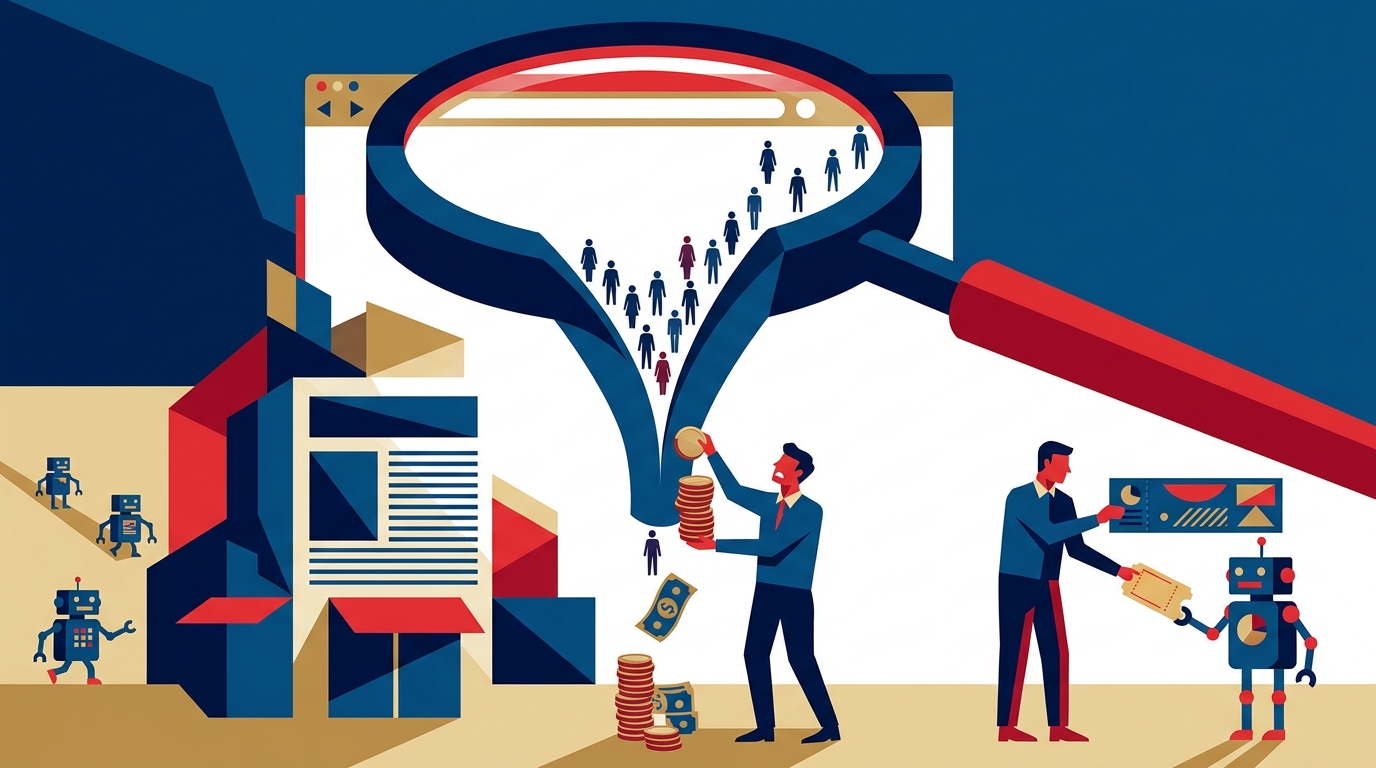
Publishers Are Paying to Rent the Audience They Used to Get Free
Source: A Media Operator, Jacob Cohen Donnelly, building on reporting from Adweek.
As Google’s AI Overviews keep more readers from ever clicking through, publishers are doing the only thing left to refill the pipe: buying the traffic back. Adweek reports that publishers’ paid-search budgets have risen 274% in the last three years, with the largest players now spending hundreds of millions a month bidding on the same clicks search once delivered for nothing. Forbes spent an estimated $72.2 million on paid search in July alone — up 34% year over year and more than eightfold over three years — while its organic search traffic fell 26.7%. The New York Times more than doubled its paid-search spend to $11.3 million; CNN’s organic traffic dropped 28.9% and USA Today’s 24.1% over the same stretch.
Cohen Donnelly names the dynamic for what it is: a prisoner’s dilemma. If every publisher stopped buying, the keywords would cost less — but no one can enforce that restraint, and the fintechs and sportsbooks would happily bid up whatever the publishers vacated. So everyone bids, and the price of the audience keeps climbing. The tell is in the same week’s Status report that Business Insider’s new chief, Christian Baesler, warned staff the traffic-driven model is simply collapsing. Renting readers is the reflex of a business built for volume; it papers over the fact that volume was never a moat.
The distinction that matters is what the money buys. Paid traffic that exists to inflate ad impressions is unprofitable by design — you’re paying for a visitor who leaves and never returns. Paid traffic aimed at a subscription, a ticket, a commerce sale, or even a newsletter signup that brings the reader back can pencil out. The Times treats paid as an opportunistic lever behind its own journalism, not a substitute for it; Morning Brew built a list spending on acquisition because it captured the email and kept the relationship. The publishers who survive Google Zero won’t be the ones who spent the most to replace free clicks with expensive ones. They’ll be the ones who used paid spend to buy a relationship a search engine can’t revoke.
The Counter-Bet: Sell Ads to the Bots
Source: The Media Copilot, Pete Pachal, in conversation with Oasy co-founder Choy Travers.
If one camp is paying to win humans back, another is trying to monetize the machines. Cloudflare says bots now outnumber humans on the web, and most publishers treat that as a threat to block. Amsterdam startup Oasy is built on the opposite bet: detect the AI crawlers on a site and serve them sponsored content human readers never see, wagering that an AI system will surface it when answering someone’s question. Publishers get the tool free; advertisers buy on a CPM for bot traffic. Travers calls the category “generative engine advertising,” and points out that blocking crawlers means deleting yourself from the fastest-growing search channel there is.
The obvious objection is that this looks like cloaking — showing a machine something the human never sees — and Perplexity has said as much. Travers’ answer is engineering: every sponsored snippet carries its disclosure as a single inseparable chunk, so a model can’t ingest the message without the label; if the platform strips it, the liability sits with the platform. The weak spot he concedes is measurement. Attribution in AI search is a billboard on the motorway — you know it was seen, you can’t prove who bought because of it. His argument is that advertisers will live with that the way they lived with out-of-home, because the alternative is sitting out AI search while competitors don’t.
What makes Oasy worth watching isn’t whether this exact model wins. It’s that it forces the questions the whole industry is about to face: what is a bot impression worth, what does disclosure mean to a machine, and who is liable when the label disappears in a summary. Licensing deals — the option everyone points to — pay the handful of publishers big enough to sign them and leave the other 90% scraped for free. Blocking makes you invisible. Selling to the bots is one of the first serious attempts at a fourth answer, and even a flawed fourth answer beats the three that are already failing most of the market.
The WordPress angle: Every one of these choices — block the crawler, allow it, or serve it something different — is a decision made at the platform and edge layer, not in the newsroom. Whoever controls how a site identifies a bot and what it returns controls whether “sell ads to the machines” is even an option. As bot traffic becomes a revenue question rather than a security one, that capability moves from the ops backlog to the business plan.
📺 Big Media Moves
CBS’s Numbers Keep Falling — and Its Defenders Have Conflicts
Source: Status, Oliver Darcy — ⚠️ Paywalled — summary based on available preview only.
The Bari Weiss era at CBS News is not off to a soft start; it is off to a collapse. The 60 Minutes season premiere drew the worst debut ratings of the 21st century — roughly 7.94 million viewers, down 21% year over year and 33% in the 25–54 demographic — and Status reports that both CBS Evening News and CBS Mornings have hit their lowest viewership levels of the century on her watch. Into that, Puck’s lead media reporter Dylan Byers published a column defending Weiss “to unusual lengths,” even as Puck pursues a lucrative deal with one of Paramount’s top investors.
Two things are worth separating here. One is the audience math: a viewership assembled over decades on institutional authority does not automatically follow a brand into a more personality-driven, opinion-forward era, and the opening numbers suggest it isn’t. The other is the coverage math. When the reporters an industry relies on to scrutinize its biggest players are financially entangled with those same players, the accountability layer thins out precisely when it’s needed most. Layer on the FCC clearing foreign investment in Paramount’s new ownership the same week, and the picture is a major American news institution being remade under conditions its own press corps is compromised to cover.
Taboola Buys Dianomi to Deepen Its Financial-Content Reach
Source: Mumbrella.
Taboola agreed to acquire native-advertising firm Dianomi for up to £27 million (about A$56 million), with a base valuation near £19 million. Dianomi specializes in financial and business content placements, a higher-value niche than the general recommendation widgets Taboola is known for. In an open web where the free traffic is drying up, the ad-tech layer keeps consolidating around whoever can promise advertisers verified, contextually premium inventory — because that’s the part of the model AI hasn’t yet commoditized.
📎 Also Noted
🔹 Nine Entertainment’s market capitalization fell to an all-time low of about A$1.21 billion after a Friday slide on the ASX, even after a strong upfront event — a reminder that a good sales pitch doesn’t outrun a weak structural story. (Mumbrella)
🔹 Australia’s ABC is cutting 46 production roles across its Screen division, and new news chief Simon Robinson would not rule out further reductions. (Mumbrella)
🔹 Meta’s Oversight Board ordered the removal of a deepfake video and called the company’s safeguards “fundamentally inadequate,” a rare on-record rebuke as synthetic media moves from edge case to daily moderation problem. (Mumbrella)
🔹 Axios previewed a two-part Media Trends Executive deep dive on AI copyright, flagging cross-border training loopholes and a shift toward retrieval-based licensing that ties publisher pay to how content actually gets used. (Axios, Sara Fischer and Kerry Flynn) ⚠️ Paywalled.
🧭 Takeaways
- Buying traffic is only smart when it buys a relationship. Paid search that funnels to a subscription, a purchase, or a returning-reader signup can pay off; paid search that just replaces free clicks with expensive ones is a slow bleed dressed up as a strategy.
- The bot question is now a revenue question. Every publisher will decide — deliberately or by default — what to do with crawler traffic. Block and vanish, allow and get scraped, license if you’re big enough, or experiment with selling to the machines. Doing nothing is still a choice, and it’s the worst-paying one.
- Volume was never the moat. The businesses panicking hardest are the ones built to convert cheap search and social traffic. The ones absorbing the same pressure calmly spent the last decade building a habit a summary can’t reproduce.
- Watch who’s doing the reporting. As media companies get bought and remade, the outlets covering them are cutting their own deals with the same investors. Read the byline’s business model alongside the byline.