Media Trendlines — October 5, 2026
📰 Key Themes
- Commonwealth Bank signed a collective license to let its employees put Australian news into workplace AI tools, the first deal of its kind that pays publishers for how AI uses journalism rather than how AI is trained on it.
- ChatGPT’s ad business reached a $1 billion annual run rate in 200 days and is now adding visual ads and third-party measurement, while the industry still has no audited way to count how often publisher content shows up in its answers.
- CNN’s Mark Thompson agreed to stay under Skydance without a signed contract, and the editorial independence board meant to protect CNN and CBS News will be shaped by the owners it is supposed to check.
- Newsletter publisher 1440 is profitable at roughly $27 million a year, and it is betting that serendipity, not personalization, is what keeps readers from settling for an AI summary.
Jump to: 💡 Business Model Innovation · 📺 Big Media Moves · 📎 Also Noted · 🧭 Takeaways
💡 Business Model Innovation
An Australian Bank Just Showed Publishers Which AI Right Is Worth Selling
Source: Mumbrella — Nathan Jolly; 🎙️ Decoder (The Verge) — Nilay Patel with Sen. Adam Schiff
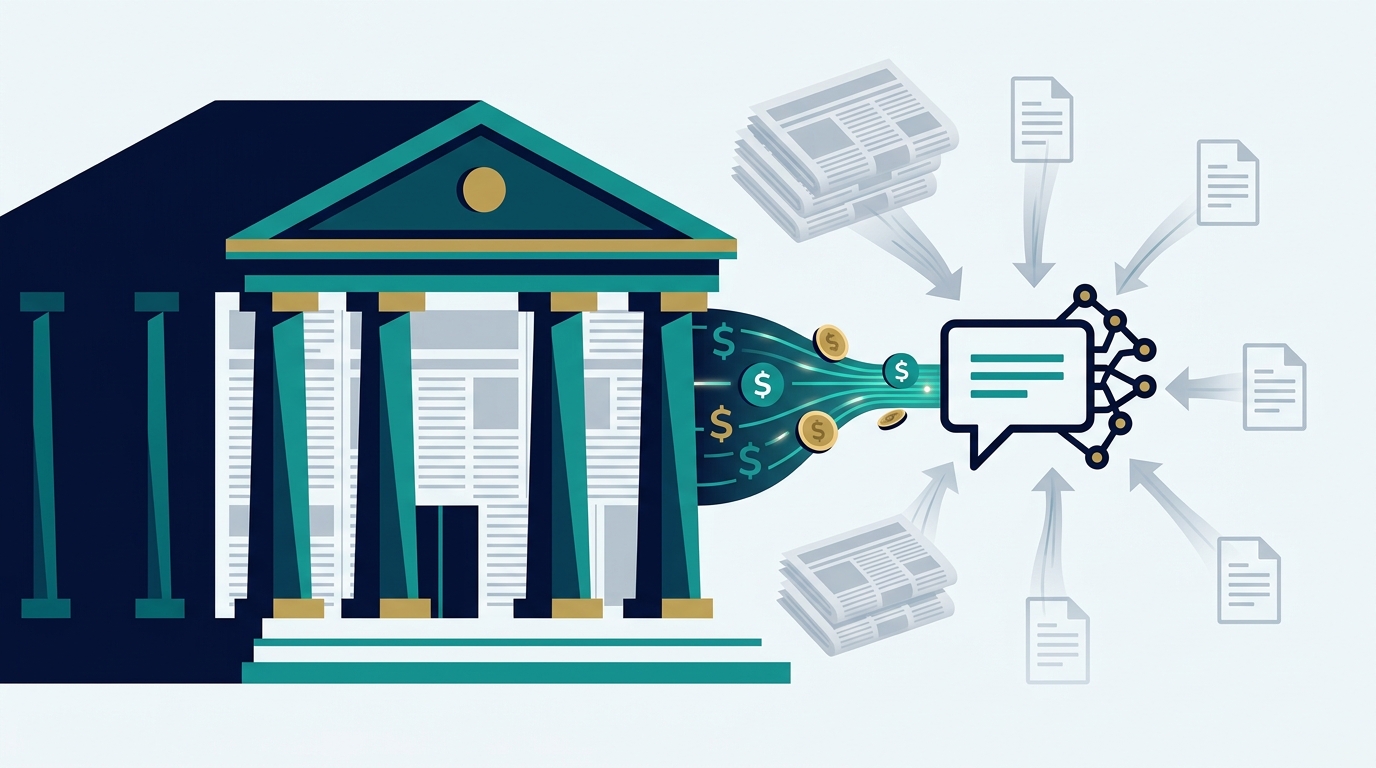
Commonwealth Bank has signed a license that lets its staff use Australian news content inside the bank’s workplace generative AI tools: summarizing articles, drafting documents, building presentations. The deal was brokered by the Copyright Agency, a not-for-profit collecting society, and the money is paid as a pooled distribution to eligible rights holders rather than per article pasted into a prompt. It explicitly does not cover training. “Permission for one use does not mean permission for every use,” said Copyright Agency CEO Josephine Johnston, who wants other employers to sign similar deals. Research the agency commissioned last year found at least 64% of Australian office workers use generative AI at work, and close to half of them put third-party copyrighted material into prompts every week.
Most of the publisher fight over AI has been about training: who scraped what, and what it should have cost. That fight matters, and it is still largely stuck. On Decoder, Adam Schiff said he and Republican Sen. John Curtis want to start by forcing AI companies to disclose and retain records of the copyrighted material used to train their models, and only then argue about fair use. That is a sensible first step, and it is also an admission that years after the scraping, Congress cannot yet say what was taken.
The Commonwealth Bank deal goes around that stalemate. Training is a one-time event that happened years ago. Usage happens every working day, inside thousands of companies, and it can be licensed the way photocopying and music in shops have been licensed for decades: collectively, at a flat rate, without tracking each use. Collecting societies like this already exist in most markets. Publishers who have spent two years chasing individual checks from a handful of AI labs should notice that the larger and steadier buyer may be every large employer whose staff are already pasting their journalism into Copilot and ChatGPT. It is the usage, not the training, that keeps happening.
ChatGPT Is Building a Measured Ad Business on Answers Nobody Measures
Source: Mumbrella — Eleanor Dickinson
Eight months after opening ChatGPT to advertisers, OpenAI has signed measurement and attribution deals with AppsFlyer, Triple Whale, Adjust, DV Rockerbox and Northbeam for sponsored placements on its free and Go tiers. It is also starting a US test of a visual ad format that runs alongside generated images, labeled and kept separate from the image itself. OpenAI repeated that ads do not influence ChatGPT’s answers. The platform hit a $1 billion annual advertising run rate last month, 200 days after opening to brands, and says tens of thousands of advertisers are using its self-serve tools.
The detail worth noticing is in the same story. IAB Australia recently asked for independent, audited measurement of AI platforms, including how often Australians use them and how frequently publisher content is surfaced through them. Advertisers are getting click attribution down to the conversion. Publishers still cannot get an audited count of how often their reporting answers a question. ChatGPT has become an ad-supported media business in under a year, built partly on top of other people’s journalism, and the measurement is flowing in one direction only. Publishers negotiating with AI companies should make citation and surfacing data a condition of any deal, not a favor to ask for later. The advertisers already got theirs.
1440 Is Betting That Serendipity Is the One Thing AI Summaries Can’t Copy
Source: A Media Operator — Kari McMahon
1440 has reached about $27 million in annual revenue, has been profitable for four years, and has never raised a traditional equity round. Nearly all of that revenue is advertising, most of it from the five-minute Daily Digest. The company adds roughly 200,000 subscribers a month across its lists, keeps about half, and holds open rates above 65%. Deputy editor Julie Shain becomes editor-in-chief of the Daily Digest, while Sony Kassam moves to executive editor to extend 1440’s approach across a growing set of products. The centerpiece is Topics, a library of evergreen explainers that is getting a browsable feed, tied to new podcasts and video. All of it will stay free.
The interesting part is the reasoning. Chief content officer Drew Steigerwald says business readers don’t open the Daily Digest for business news; they open it for science and tech they didn’t know they cared about. That cuts against a decade of personalization strategy, and it gives 1440 a credible position against AI: a chatbot answers the question you asked, but it is bad at handing you the one you didn’t think to ask. A curated feed of things worth knowing is a product an AI answer engine doesn’t replace. The risk is the old one. Turning an inbox habit into a destination habit is the step most newsletter businesses have failed to make, and 1440 is trying it with a free, ad-funded product competing for the same spare minutes as TikTok.
The WordPress angle: Kassam’s stated goal is for research done for one Topic to feed podcasts, video and social instead of “disappearing after a single piece is published.” That is a content-modeling problem before it is an editorial one. Publishers that store explainers as structured, reusable entities, with their facts and sources and relationships kept as data rather than baked into a finished article page, can repackage them into any format and serve them cleanly to AI systems too. Publishers that store everything as finished pages end up rewriting the same research for each format.
📺 Big Media Moves
CNN’s Independence Under Skydance Rests on Contracts Nobody Has Signed
Source: Status — Jon Passantino (editor) ⚠️ Paywalled — summary based on available preview; 🎙️ Decoder (The Verge) — Nilay Patel with Sen. Adam Schiff
Shortly after 9 a.m. Monday, CNN chief Mark Thompson told staff he would stay on under Skydance, saying he was “convinced” that David Ellison and his team “believe in news alongside entertainment as a top strategic opportunity.” The announcement ended speculation that Bari Weiss would add CNN to her portfolio. Status then reported what the memo left out: Thompson has not finalized a new contract, and he is not the only top CNN executive whose deal runs out in 2027. HBO’s Casey Bloys, by contrast, has now signed one.
On Decoder, Schiff raised the structural version of the same problem. The merger agreement includes an editorial independence board meant to oversee CBS News and CNN, but, as he put it, the board appointed by the Ellisons will decide how it is constituted. “So is this real or is this going to be a fiction?” A newsroom’s independence is only as strong as the people with the power to defend it, and right now the most important of them is working without a signed deal while the oversight body answers to the owner. Staff and readers should judge CNN’s independence by what gets signed in the next six months, not by what was written in Monday’s memo.
📎 Also Noted
🔹 Australia’s Nine and Seven are launching a joint BVOD venture in early 2027, citing estimates that more than $300 million a year is lost from the country’s $1 billion BVOD market to opaque tech fees and programmatic supply-chain bloat. Meanwhile, the AFL and NRL grand finals each drew more than 4.2 million viewers on free TV. (Mumbrella)
🔹 WIN Television will stop carrying Network 10 in three regional Australian markets from October 9 after its short-term agreement with Paramount ended, citing high transmission costs and falling audiences and ad revenue. (Mumbrella)
🔹 Sports Entertainment Network passed one million unique monthly podcast listeners for the first time in September, with 4.4 million downloads and web and app streams up 51% year over year. Live sport audio is turning into an on-demand audience. (Mumbrella)
🔹 Jon Cook, global CEO of VML and head of WPP Creative, will leave WPP after three decades; VML North America CEO Eric Campbell takes over in March 2027. (Mumbrella)
🔹 Also in Monday’s Status: former White House press secretary Karoline Leavitt is joining Fox News, the edition’s headline has Trump grounding POLITICO in the administration’s continuing press-access fight, and an OpenAI publicist interrupted a Sam Altman interview. (Status) ⚠️ Paywalled
🧭 Takeaways
- License the usage, not just the training. Training happened once. Employees pasting news into AI tools happens every day at every large company. Publishers should push their collecting societies and trade groups to build blanket workplace AI licenses now, before that usage becomes an accepted free habit.
- Make surfacing data a condition of every AI deal. ChatGPT gives advertisers five attribution partners and gives publishers nothing comparable. Any licensing or partnership agreement should require regular, auditable reporting on how often a publisher’s content is cited and surfaced.
- Treat governance promises as unsigned until they are signed. CNN’s leader has no new contract and its independence board will be shaped by its owners. In any newsroom changing hands, the reliable measure of editorial protection is the paperwork, not the memo.
- Curation is a defensible product against AI. 1440 shows that a free, profitable, ad-funded publisher can grow by surfacing what readers didn’t ask for, which is exactly where answer engines are weakest. Publishers with strong editing should sell that judgment openly instead of hiding it behind personalization.