Media Trendlines — September 18–20, 2026
📰 Key Themes
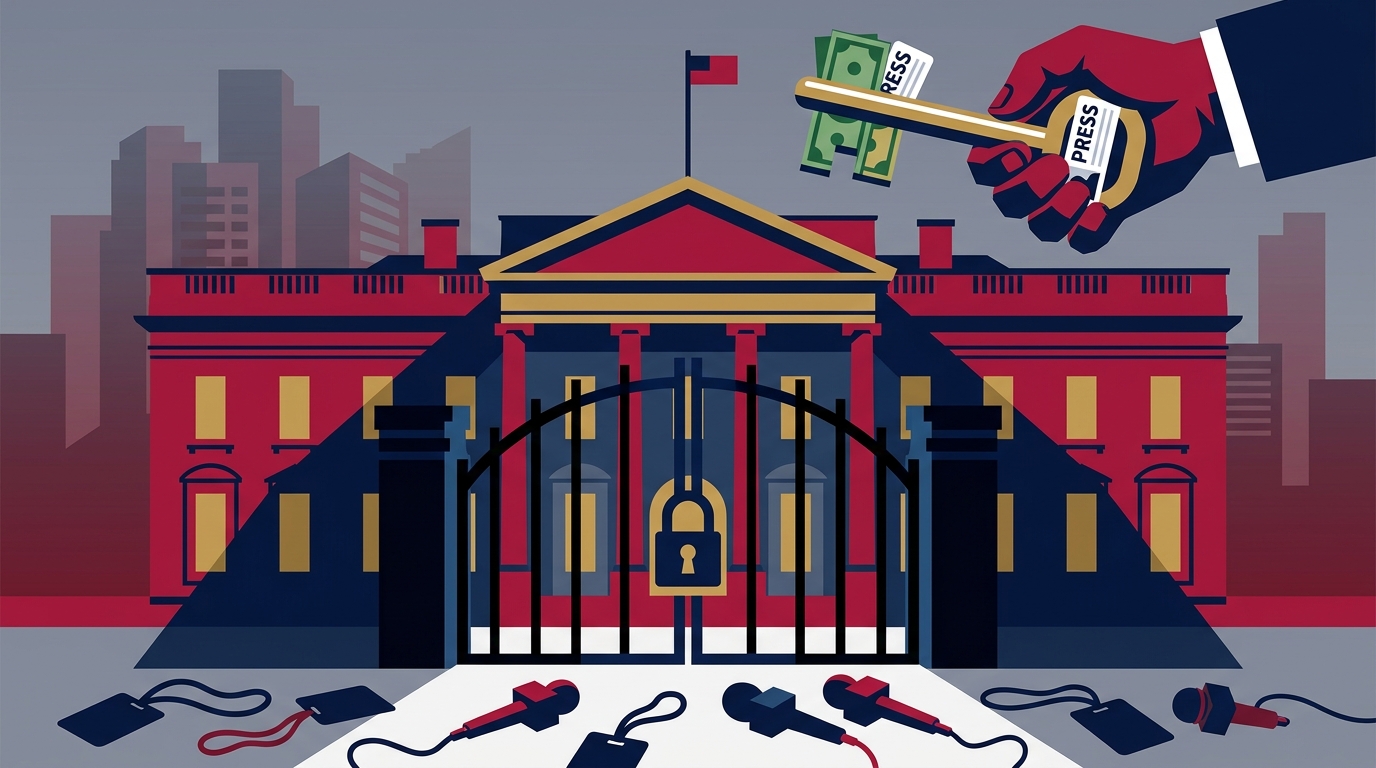
- Trump banned CNN, MS NOW, and Politico from the White House effective immediately, and the three outlets moved to sue over their First Amendment access.
- Paramount reached a settlement with the last holdout states, clearing the biggest media merger in years after one of the most expensive antitrust fights in U.S. history.
- Roundtable struck a 10-year, one-billion-dollar deal to run the business of the publisher formerly known as The Arena Group while the brands keep their names, domains, and audiences.
- A cluster of deals showed operators pulling their most profitable pieces into standalone entities, betting the parts are worth more sold separately than held together.
- The subscription playbook is shifting from unlimited access to flexible, relationship-first models that reach readers outside the existing subscriber base.
Jump to: 📺 Big Media Moves · 💡 Business Model Innovation · 🎙️ From the Pods · 📎 Also Noted · 🧭 Takeaways
📺 Big Media Moves
Banning Three Newsrooms Turns Access Into a Weapon — and the Industry Knows It
Source: Axios, Sara Fischer; Status, Oliver Darcy; and Semafor, Ben Smith.
Late Friday, President Trump banned CNN, MS NOW, and Politico from the White House “effective immediately,” a move that blindsided the outlets and some administration officials alike. By Monday the three had said they would sue to protect their First Amendment rights, with CNN retaining a First Amendment attorney and legal action expected within days. Notably, the reporter who leads the White House Correspondents’ Association — Jacqui Heinrich of Fox News — immediately defended her ousted colleagues.
Semafor’s Ben Smith read the maneuver as an old playbook rather than a new one: a president decides he can talk only to friendly media, governing gets complicated, and persuasion runs back through the adversarial press he tried to shut out. The ban, he wrote, was greeted with a mix of “shrugs and solidarity.” That phrase is the tell. When barring three major newsrooms from covering the government produces solidarity but not a unified refusal to normalize it, the punishment stops being a cost and becomes a tool. Access is now something an administration can grant and revoke to shape who gets to report on power — and the muted collective response confirms how little leverage the outlets have to push back. The lawsuit is the right move precisely because the informal norms that used to make a ban unthinkable have already failed.
Paramount Cleared Its Merger by Running Out the Clock, Not Winning the Argument
Source: Axios, Sara Fischer; with reporting from Puck’s The Grill Room and Semafor.
Paramount reached a settlement with the state attorneys general who had been blocking its acquisition of Warner Bros. Discovery, ending what Axios called one of the most expensive, drawn-out, and dramatic merger fights in U.S. history. The path there was ugly. On Puck’s The Grill Room, Dylan Byers described talks with California’s Rob Bonta collapsing to the point that Paramount demanded a 1.88-billion-dollar bond from the state and floated relocating the company to Nashville or Texas — a threat that lined up neatly with David Ellison’s “red state” pitch for a portfolio built on UFC, the NFL, Taylor Sheridan, and South Park. A proposed editorial board or monitor to “safeguard CNN’s independence” was dangled to soften the concessions.
What actually moved the deal was a calendar. An October 1 deadline threatened to trigger a roughly seven-million-dollar daily fee owed to WBD shareholders, and that meter — not a resolution of the antitrust concerns — is what forced the endgame. The critics who called the combination “facially illegal” did not get answered; they got outlasted. And the promise most worth watching is the flimsiest one: an oversight board assembled to protect a newsroom’s independence has no history of binding an owner who changes his mind. A merger this size clearing on deadline pressure sets the template competitors will study — the lesson is that a determined buyer with a payment clock can convert regulatory resistance into a line item.
Roundtable Bets a Billion Dollars That Publishers Will Rent the Stack and Keep the Brand
Source: A Media Operator, Christiana Sciaudone.
Roundtable (RTB Digital) announced a 10-year, one-billion-dollar agreement with Paradium.AI — the company formerly known as The Arena Group, home to TheStreet and Athlon Sports — under which Roundtable provides technology, monetization, and operating services while Paradium keeps its brands, domains, intellectual property, and audiences. Revenue would flow through Roundtable’s platform, booked as Roundtable revenue, with 60% passed back to Paradium. Separately, Roundtable agreed to buy roughly 49.5% of Paradium from its largest shareholder at $3.80 a share, a deal it valued near 89 million dollars; Paradium’s stock surged 271% on the news. The publisher needs it — second-quarter revenue fell 51% to 22.2 million dollars and the company swung to a loss.
The structure is CEO James Heckman running back the model he built at TheMaven a decade ago: pool publishers onto shared infrastructure while they keep their marquees. The math demands skepticism. Roundtable reported just 2.33 million dollars in total revenue last quarter and a 9.58-million-dollar net loss, held about 4.1 million in working capital, and is separately suing a former platform partner over an unpaid note. Projecting a jump to a 100-million-dollar run rate on the back of a publisher whose revenue just halved — with funding conditions still unmet — is a bet on scale the buyer has not yet demonstrated it can fund.
The WordPress angle: The interesting part is the split the deal formalizes — the publisher keeps the brand, the domains, the audience, and the IP, while a third party runs the technology and monetization stack. That is a decision made at the platform layer, and it only works cleanly when a publisher’s content, identity, and data are portable enough to hand the plumbing to someone else without handing over the business. Owning the CMS and the audience relationship while renting the revenue engine is a coherent bet only if the underlying platform was built to be separable in the first place.
💡 Business Model Innovation
The Profitable Part Is Worth More Walking Out the Door
Source: A Media Operator, Jacob Cohen Donnelly.
In late 2025, Jacobs Media Group — a 15-million-pound travel and hospitality media and events company — quietly moved its most profitable brand, the events business Connections, into a newly created entity ultimately owned through a Dubai free zone and controlled by founder Clive Jacobs. Connections generated 3.8 million pounds in revenue and cleared a 27% net margin the year before; without it, the parent would have posted a loss. The accounts called the move a “disposal,” though the company told AMO it was “simply an internal restructure.” No cash proceeds were recorded, and a loan owed to the group by a connected entity grew from 1.6 to 3.4 million pounds over the same year.
Strip away the terminology and the logic is clean. A one-to-one events business trades at a 6-to-9x multiple; a digital media business with print exposure trades lower and gets discounted further by bankers wary of print. Housing the high-margin brand in a low-tax jurisdiction with clean books sets up a richer exit than it would ever command buried inside a diversified media group. This is the same question the Vox Media breakup and the Zonda sale to CoStar already forced: whether blended portfolios of media and non-media assets are worth more together or apart. The market keeps answering apart — and every operator sitting on a profitable events or data arm attached to a slower-growing publishing business is going to face the same temptation.
The Subscription Winners Are Unbundling Commitment From Access
Source: The Audiencers, Madeleine White.
A survey of the paywall experiments publishers are running right now points in one direction: the all-or-nothing subscription is no longer the default. The Washington Post is testing micropayments — day passes, week passes, and pay-per-article — and found that 42% of flexible-access buyers were brand-new, anonymous users from outside its ecosystem, with up to 8% of week-pass buyers converting to full subscriptions over 180 days. Canada’s Les Coops de l’information let readers name their price and pulled an average of 3.12 dollars against a one-dollar floor, with 84% of sign-ups coming from people who had never subscribed. SFGATE kept its web free and sold a separate paid app instead of drawing a paywall through its content.
The other half of the shift is depth over volume. The Economist paired a 15-dollar audio-and-video tier with a premium interview series that 75% of subscribers have engaged with, and churn falls the more they do. WIRED rebuilt its subscription around five habit-forming newsletters, cadenced live AMAs with beat reporters, and expanded commenting — an explicit move to turn passive readers into participants. The throughline across both halves is that conversion is a relationship built in micro-steps, and the growth is coming from readers the old unlimited-access wall never reached. Publishers still treating the annual subscription as the only door are leaving the newest buyers standing outside it.
A Profitable B2B Publisher Takes Outside Money to Buy the Fragments Around It
Source: A Media Operator, Kari McMahon.
Information Security Media Group spent nearly two decades profitable and self-funded — 38 digital properties, two million subscribers, more than 400 events a year — before taking an investment from Peak Rock Capital to grow four- to five-fold in five years. The plan is acquisition: rolling up a fragmented cybersecurity media, training, and events market, favoring businesses founded by former practitioners. The quieter asset is data. A decade of tracking attendance, downloads, and engagement now underpins a set of planned AI products and a pitch to advertisers who increasingly want behavioral signals, not subscriber lists. In a niche where Gartner pegs security spending at 244 billion dollars this year, ISMG is betting the moat is the proprietary record of what its audience actually does.
🎙️ From the Pods
If Human Writing Becomes Scarce, Someone Will Sell the Proof of It
Source: Mixed Signals (Semafor), with Pangram CEO Max Spero.
Pangram’s Max Spero builds AI-detection models, and his framing is the one worth keeping: as machine-generated text becomes abundant and nearly free, verified human authorship becomes the scarce, valuable thing. His tool claims a false-positive rate of one in ten thousand and can already tell the writing signatures of different models apart — the verbose, over-hedging cadence of one, the clipped staccato of another. It powers a disclosure feature on Substack and is aimed next at law firms, schools, and publishers.
Human touch is about to become the scarcest thing on the internet.
Set that next to WIRED rebuilding its subscription around “connecting our humans to all of you humans,” and a pattern appears. The same abundance that makes content cheap is turning authenticity into a product — something to certify, disclose, and charge for. Spero concedes the cat-and-mouse game with “humanizer” tools never really ends, which is the honest caveat: detection is a moving line, not a fixed guarantee. But the market signal is clear enough. Publishers whose entire value rests on being demonstrably human should expect readers, and eventually advertisers, to start asking them to prove it.
📎 Also Noted
🔹 OpenAI copied millions of news articles to make its technology worth “gazillions,” according to a filing in The New York Times’ lawsuit against the company, the FT reported. (Semafor)
🔹 Brazen, the investigative studio founded by former Wall Street Journal reporters Bradley Hope and Tom Wright, raised 2.6 million dollars from Singapore’s Lotus Group — a counter-cyclical bet on original reporting as much of the industry retreats from it. (Semafor)
🔹 Wired shut down its Made in China newsletter, a reminder that even a genuinely important beat struggles to hold a U.S. audience. (Semafor)
🔹 California Governor Gavin Newsom signed a law penalizing influencers who fail to disclose that a campaign paid them, part of a slow tightening around undisclosed political promotion. (Semafor)
🔹 Avail’s new creatorAPI lets creators generate audience-tailored variants of their ads, pitched as a way to “scale yourself like software” against fully synthetic AI influencers. (Semafor)
🔹 Kai-Fu Lee warned that Hollywood’s plan to bolt AI onto its existing model is “a little bit of a moat” against AI-native studios already churning out microdramas: “The game will be over in a couple of years.” (Semafor)
🔹 A Pew study found strong majorities call it unacceptable to remove posts merely for being partisan (72%) or critical of the government (71%), even as most accept takedowns of outright falsehoods. (Semafor)
🧭 Takeaways
- Access is leverage, and most newsrooms are short on it. When barring three major outlets earns solidarity but no unified line, the punishment becomes a repeatable tool. The response that matters is structural — legal standing and shared norms — not statements.
- A payment clock now beats an antitrust argument. Paramount cleared its merger on deadline pressure, not resolved concerns. Expect buyers to treat regulatory resistance as a cost to outlast, and treat “independence” guarantees as the least durable term in any deal.
- The profitable part is worth more sold separately. Events arms, data businesses, and high-margin brands keep getting extracted from slower-growing publishers because the market rewards the clean, standalone asset. If you run a blended portfolio, someone is already doing this math on you.
- Stop treating the annual subscription as the only door. Micropayments, pay-what-you-can, and depth-first tiers are reaching buyers the unlimited-access wall never touched. Conversion is a relationship built in steps, and commitment can be unbundled from access.
- Authenticity is turning into a product. As machine-written content floods every feed, being demonstrably human becomes something to certify and charge for. Publishers built on trust should plan to prove it, not just claim it.